REVIEW · EDINBURGH
Makars Mushroom Farm Summerhall Tour with DIY Block Making
Book on GetYourGuide →Operated by Makars Mushroom Farm · Bookable on GetYourGuide
A basement mushroom farm sounds like a secret, not a plan, but it works surprisingly well. You get a guided look at Lion’s Mane cultivation in sterile grow rooms, and I love how the tour ends with hands-on DIY block making you can take home. The vibe is friendly and practical, yet there is one catch: the whole experience takes place underground, so it may feel tight if you’re claustrophobic.
What makes this one click is that it’s not just facts. You see the real workflow for growing fungi—how grain becomes incubating spawn, how fruiting happens, and what to monitor to get a healthy crop. I also like the time-and-effort value here because you’re not leaving empty-handed; you inoculate a block and get a clear idea of what comes next.
If you want fresh air and wide-open spaces, this isn’t that kind of outing. Also note it’s not suitable for wheelchair users, and kids under 10 can’t join.
In This Review
- Key highlights you’ll actually care about
- Why a mushroom farm tour at Summerhall feels like a good use of an hour
- Finding Makars Mushroom Farm inside Summerhall’s underground space
- The Lion’s Mane storyline: from grain production to fruiting tents
- Inside the sterile workflow: what you learn, and what you can actually use
- Fruiting tents and monitoring oxygen, water, and nutrients
- The best ending: inoculate your own block and plan for the wait
- Price, time, and value: is $13 a fair deal for all this?
- Who should book this (and who might want to think twice)
- Should you book the Makars Mushroom Farm Summerhall tour?
- FAQ
- How long is the Makars Mushroom Farm Summerhall tour with DIY block making?
- What will I learn during the tour?
- Do I get to take something home?
- How long until my block fruits?
- Is the tour suitable for children?
- Is the tour wheelchair accessible?
Key highlights you’ll actually care about
- Underground, sterile mushroom rooms in a disused basement at Summerhall, Edinburgh
- Hands-on inoculation: you make your own mushroom block to take home
- A clear Lion’s Mane walkthrough from grain production to incubation and fruiting
- Fruiting-tent monitoring: oxygen, water, and nutrients—what matters and why
- Timelapse fruiting videos that make the wait feel shorter and more understandable
- Small group size (up to 8) so your questions don’t get lost
Why a mushroom farm tour at Summerhall feels like a good use of an hour
This tour is built for one thing: turning fungi from a vague curiosity into something you can picture in your head. Fungi are often treated like side characters in nature, but here you learn why they matter—how they can fit into our food system and nutrition conversation, and why growing them reliably is more about controlled conditions than luck.
I like that it’s taught in plain language. You don’t need a biology background to follow what’s happening in the rooms. The guide moves step-by-step through the cultivation cycle, and the final DIY session makes the whole process feel tangible. At the end, you’re not just thinking about mushrooms; you’re thinking about your block.
It’s also a strong choice if you enjoy hands-on learning. The whole experience stays focused and time-efficient: 1 hour, small group, and a practical finish.
Finding Makars Mushroom Farm inside Summerhall’s underground space
The tour starts at Makars Mushroom Farm, set in a disused underground basement within Summerhall, one of Edinburgh’s arts venues. That location is part of the charm and part of the caution. It’s cool in the literal sense—underground rooms tend to stay controlled for growing—but you also need to be comfortable in closer spaces.
Meeting instructions are straightforward if you follow them exactly. Go into the main entrance, then head to the back door where you’ll find stairs. Walk downstairs and follow the signs for the machine room. Then turn left and follow the signs down the corridor until you reach the end.
In terms of getting to Summerhall, you have practical options. The venue sits in an easy walking area through the Meadows, and it’s bike-friendly too (bikes can be brought inside or locked in racks). If you’re using public transport, several Lothian Bus routes serve South Clerk Street, and some stop right outside the main entrance. Parking exists, but it’s limited street meter parking, so plan for that.
One more thing you should keep in mind: English live guide, and the group is limited to 8 participants. That small size helps the guide pace the tour so you’re not just watching while thinking about the next stop.
The Lion’s Mane storyline: from grain production to fruiting tents
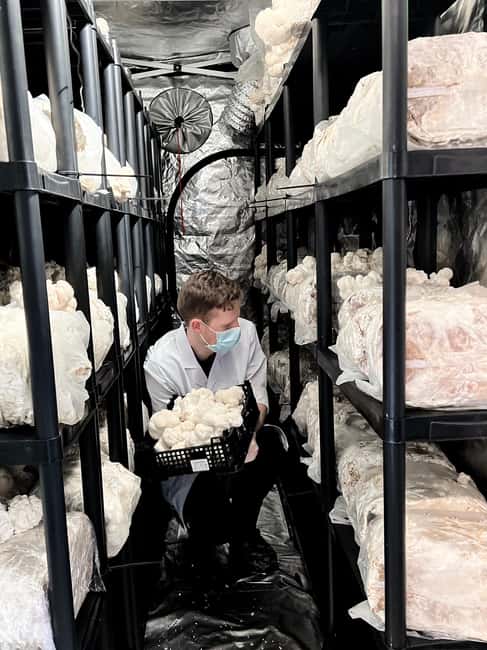
The tour’s core subject is Lion’s Mane, and the best part is how the guide connects each stage. Instead of jumping straight to the fun, you start with what comes first: grain production. You learn that mushroom cultivation isn’t one single action—it’s a sequence of phases where each step sets up the next one.
Here’s how the flow typically lands in your brain during the tour:
First, you hear how cultivation begins with materials prepared for growth. Then you move into incubation, where the goal is letting the culture establish in a controlled environment. This is where sterile technique matters most, because contamination can ruin a batch.
Next comes fruiting. The guide explains that fruiting is not just a “wait until mushrooms appear” situation. It’s driven by environmental factors, and the farm handles those with purpose—using fruiting tents designed for reliable results.
As you walk through the space, you see how that theory becomes practice. You’ll spot the sterile conditions and the methods used to keep the environment controlled. Then you shift into the part that makes the whole thing feel real: learning how to monitor the crop as it develops, not just when it’s almost ready.
Inside the sterile workflow: what you learn, and what you can actually use
The tour’s sterile-environment focus sounds technical, but it’s explained in a way you can use immediately. The point isn’t to turn you into a lab technician. The point is to show you why growers treat cleanliness and control like the foundation, not a side detail.
During the tour, you learn what sterile conditions mean in practice and why they support reliable cultivation of exotic mushrooms like Lion’s Mane. You also get a sense of the mindset: you’re managing a process where small mistakes can matter.
A big takeaway for me is how the guide frames contamination and control as “part of the job,” not as mysterious luck. Once you understand that, the later DIY step makes more sense. You’re not hoping your block works; you’re learning enough to understand what will influence outcomes.
You’ll also discuss what to look for before harvest. That matters because it teaches you how growers evaluate progress. Instead of treating mushrooms as a switch that flips from nothing to mushrooms, you learn to watch for signs of readiness and crop health.
Fruiting tents and monitoring oxygen, water, and nutrients
The fruiting tents are where your attention starts to sharpen. This isn’t just scenery; it’s where the farm’s success shows up. You learn how growers monitor key factors while the crop develops, including:
- Oxygen levels
- Water management
- Nutrients and overall crop conditions
You also learn what to watch in the growing process. The guide talks through what signals a good result and what you should understand about timing and readiness.
For visitors, this is one of those moments where “wow, that’s more complicated than I thought” turns into “okay, I get it now.” You come away knowing that mushrooms fruit because conditions are right, not because you got a good batch and crossed your fingers.
And then there’s the emotional part: you’re shown timelapse fruiting videos. Watching the cycle compress on screen helps you connect the dots between the sterile work you saw earlier and the stage you’re waiting for at home.
The best ending: inoculate your own block and plan for the wait
The tour ends with your hands-on session: you inoculate your own mushroom block to take home. This is the moment that makes the ticket feel more like an experience and less like a lecture.
You’ll learn as you go, and the process is set up so you can do it during the tour rather than just receiving a pre-made kit. The upside is obvious: you leave with agency. You also get a better shot at confidence about what’s happening during the weeks after.
The expectation is that your block will fruit in about three weeks. You might also end up watching timelapse content during the tour that gives you a sense of what you’re waiting for. That timing window turns into a practical plan: you can treat the next few weeks as a single mini-project instead of a random wait for something to happen.
This is also where you’ll likely ask questions. Since the group is small, the guide can respond to your specific concerns, especially if you’re thinking about where to place your block at home or how to interpret what you’re seeing.
Price, time, and value: is $13 a fair deal for all this?
At $13 per person, this is priced in the territory of “small add-on experiences,” but it offers more than most options at that level. For one thing, you’re paying for a guided tour plus a take-home outcome. You don’t just watch sterile techniques; you do the inoculation step yourself.
It’s also efficient time-wise. With a 1-hour duration, you can fit it into a day in Edinburgh without it swallowing your whole schedule. That matters if you’re balancing museums, walks, and the usual city stuff.
The limited group size adds another layer of value. If you’ve ever been stuck in a big group where you can’t ask questions, you’ll appreciate the maximum 8 participants setup. It makes the educational parts feel more personal.
Add the timelapse viewing, and you get a complete arc: learn the method, see what success looks like, then take part of it home. For the money, that’s the key strength.
Who should book this (and who might want to think twice)
This tour is suitable for all interest levels. You do not need to be a mushroom fanatic to enjoy it. If you’re curious about food, science-in-real-life, or just want a different Edinburgh experience that doesn’t feel like another standard museum stop, you’ll likely enjoy the format.
It’s also a good fit for couples and friends who like quirky learning. It’s the kind of activity that creates conversation later, because you have a living timeline at home.
That said, you should think twice if any of these apply:
- Claustrophobia: the tour happens in an underground basement.
- Wheelchair users: the experience is not suitable because there is no accessible access.
- Children under 10: it’s not open to younger kids.
If you’re in the right category, you’ll get the real value: understanding what it means to grow reliably in sterile conditions, seeing fruiting tents, and leaving with a DIY block that you can care about for the following weeks.
Should you book the Makars Mushroom Farm Summerhall tour?
Book it if you want a short, hands-on Edinburgh experience that connects theory to real cultivation. I’d especially recommend it if you like practical learning or you want something different from the usual city sightseeing rhythm. The standout advantage is the combination of guided sterile cultivation insight and inoculating your own block so you have an outcome to look forward to in about three weeks.
Skip it if you strongly dislike underground spaces or if accessibility is a concern for you, since the basement setup can be a dealbreaker. Also be realistic about expectations: it’s educational and interactive, but it’s still a 1-hour tour, so you won’t get a long, step-by-step tutorial that replaces home research.
If you’re on the fence, this is one of the rare activities that feels like good value even when you’re not a specialist—because you leave with both knowledge and a home project.
FAQ
How long is the Makars Mushroom Farm Summerhall tour with DIY block making?
The tour lasts 1 hour.
What will I learn during the tour?
You’ll learn about the process of growing Lion’s Mane mushrooms, including grain production, incubation, and fruiting. You’ll also learn how to monitor factors like oxygen, water, and nutrients and what to look for before harvest.
Do I get to take something home?
Yes. You inoculate your own mushroom block to take home.
How long until my block fruits?
Your block is expected to fruit in about three weeks.
Is the tour suitable for children?
It is not suitable for children under 10 years.
Is the tour wheelchair accessible?
No. The tour is not suitable for wheelchair users because there is no accessible access to the underground area.